
Caddo Parish Previous-Resident Sources
No source spans every year or names every occupant. Start with a record whose date fits the period, then use another source to test the name and address. A deed is strongest for ownership. A directory or census schedule is usually more useful for the household layer.
| Source | Years found | Where kept | Address-history value |
|---|---|---|---|
| Caddo conveyance records | Series from 1839; index to 1914; scans to 1838 | Caddo Clerk, LCRAA, Clerk Connect, record room | Transfers, grantor/grantee, instrument, legal description |
| Sheriff tax rolls | 1880–1920 and 1954 | LSUS Northwest Louisiana Archives | Taxable name, address, acreage, description, and values |
| Shreveport city directories | Print 1924–present | Shreve Memorial Library Special Collections | Dated name, address, phone, and business context |
| Southern Bell directories | 1941, 1953, 1956, 1957 found | FamilySearch Digital Library | Subscriber and telephone listings |
| Sanborn maps | 1885–1935 editions; 1944/1963 revisions | Shreve Memorial Library / Digital Sanborn | Building footprint, use, street, and lot context |
| Federal census | Released schedules through 1950 | NARA, FamilySearch, library databases | Household on one enumeration date; boundary changes matter |
| Newspaper indexes | Local indexes vary from 1973 onward | Shreve Memorial Library | Obituaries, moves, marriages, sales, and local events |
For a recent property, begin with the assessor and deed. For a pre-portal address, the tax rolls, directories, Sanborn sheets, census, and newspaper indexes become the practical route.
Trace Caddo Parish Previous Owners
The deed chain gives the ownership spine for previous residents research. It begins with today’s assessed parcel, then follows one recorded transfer at a time. A person in the chain may never have occupied the site, so the household sources come later.
- Normalize the address and save its parcel ID, situs address, mailing address, subdivision, lot and block, or Section-Township-Range.
- Search the current owner as the grantee in the Caddo conveyance index. Open or request the purchase instrument.
- Record the seller, instrument number, book and page, filing time, legal description, and any prior address printed in the deed.
- Search that seller as an earlier grantee. Add a spouse, middle initial, business name, description, and date range when the name is common.
- Repeat until the online route ends. Use the instrument reference for a clerk copy request, record-room index, or older book when needed.
- Grantor
- The seller or other person transferring an interest in a recorded instrument.
- Grantee
- The buyer or other person receiving that recorded interest.
- Chain of title
- The linked sequence of recorded transfers for the same land.
- Legal description
- The surveyed land identity that can remain stable when a postal address changes.
Mortgages, releases, judgments, and tax liens may name the same people without transferring ownership. Label the instrument type before adding a name to the owner timeline.
Caddo Parish Previous Residents in Deeds
The Caddo Clerk’s property-records page explains the long conveyance and mortgage record series, access accounts, copies, and office record room.
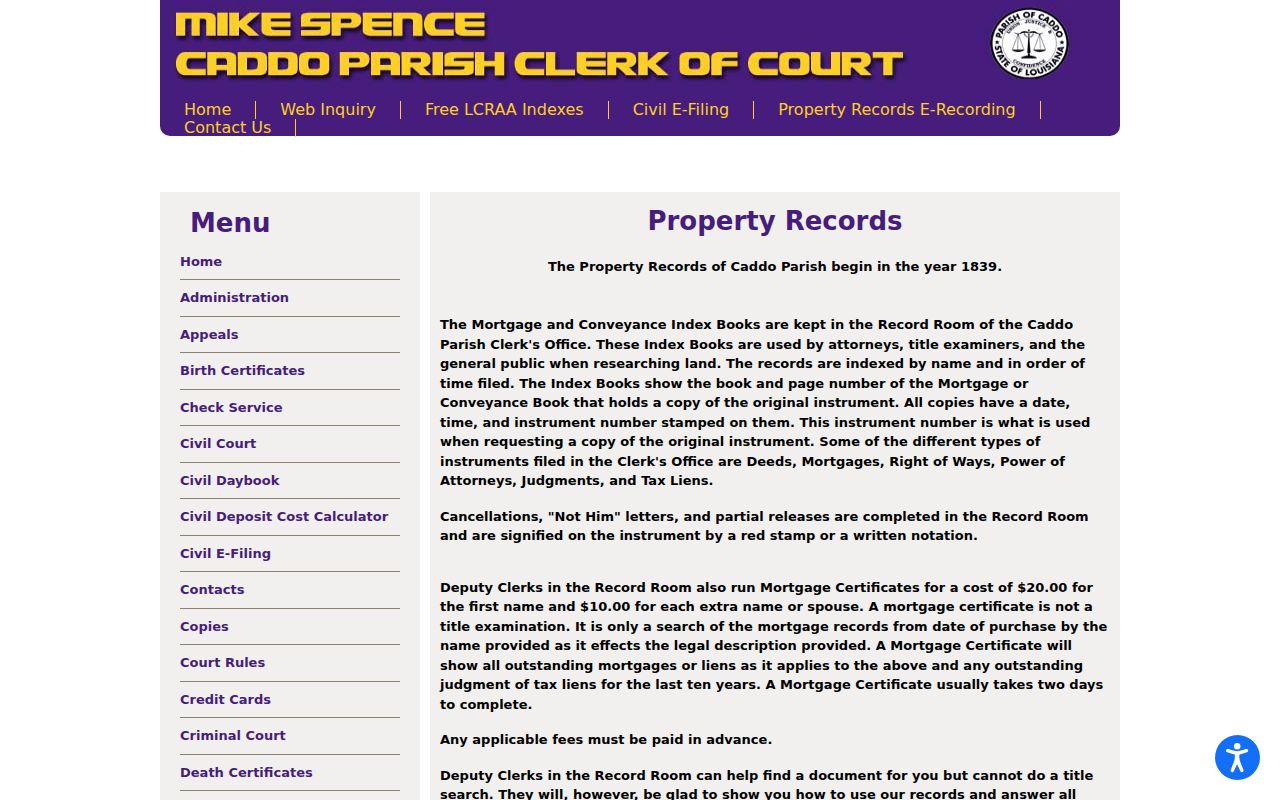
The milestones must stay separate. Property records begin in 1839. Computerized property indexing began in the early 1980s. Conveyances are indexed back to 1914, and back-scanned conveyances reach 1838. Mortgage back-scanning remains in progress. A scan date, index date, and record-series start do not promise the same online coverage.
The Louisiana Clerks’ Remote Access Authority portal provides the free public index account route for deeds and marriage records.
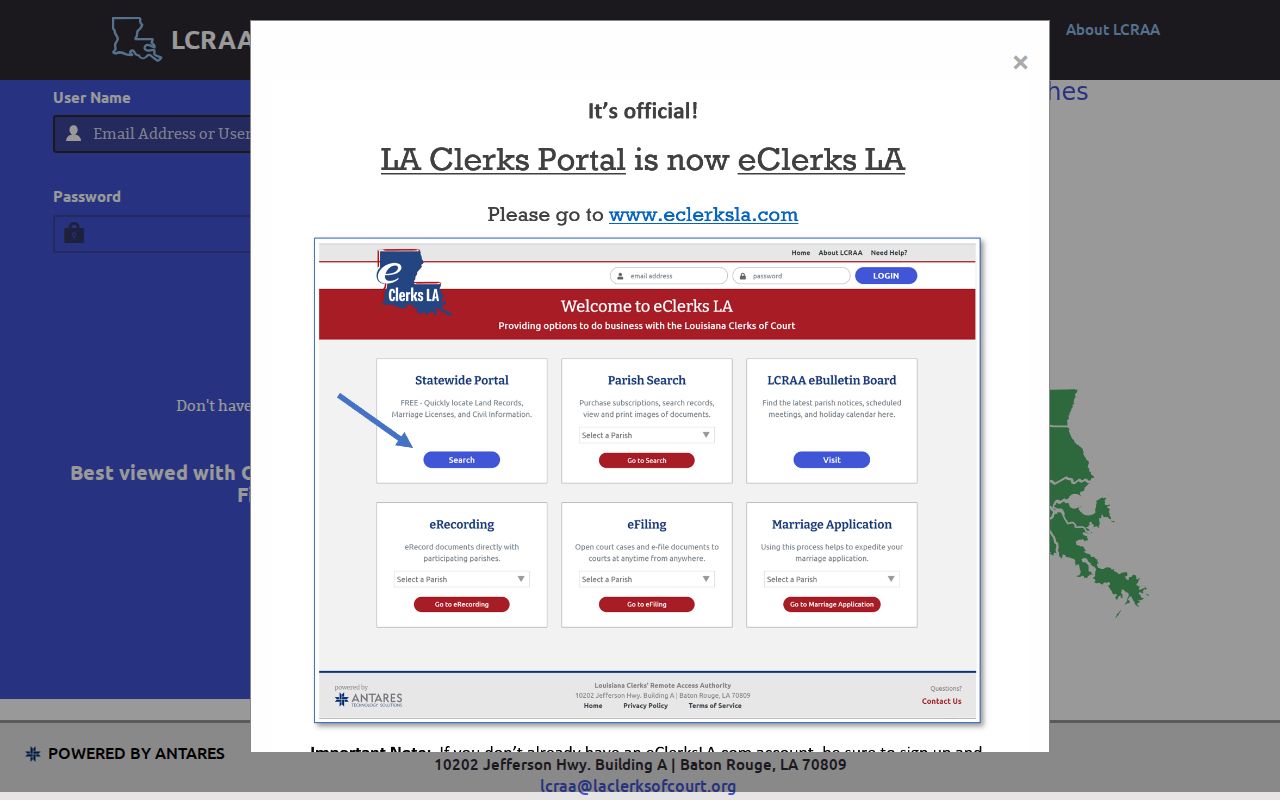
When an image is unavailable, carry the instrument number, book and page, names, and recording date into a clerk request. Clerk Connect offers paid time plans and electronic images, while the physical record room remains an access channel for older or unevenly indexed material.
When Caddo Parish Addresses Disappear
A failed old street-number search does not break the chain. The number may have changed, the street may have been renamed, or the postal last line may differ from the historic community name. No official dated Caddo renumbering schedule was found, so a precise renaming year should not be guessed.
Return to the deed’s legal description. Match the lot, block, subdivision, or tract against a plat, Sanborn sheet, historical map, and directory street index. Search both versions of a place name where the historical community list and current USPS line differ. That land-first method can reconnect an address even when modern search boxes reject the old form.
Caddo Parish Past Property Tax Rolls
LSUS Northwest Louisiana Archives holds Caddo Sheriff tax assessment roll books for 1880 through 1920 and 1954. The books can give a taxable person’s name, address, race as recorded, acreage, property description, cash value, and total assessment. Those details predate the modern parcel screen and can bridge an old name to a tract.
The collection is especially useful when the deed index yields a legal description but the street label is unclear. Compare the tax name and land description with the nearest directory year, Sanborn map, and deed. Historical race entries are source fields from their period and must not be used to infer the identity of anyone in a modern result.
This numbers-rich archive also shows why one database is not enough: more than forty years of assessment volumes plus a separate 1954 roll preserve a property trail outside today’s assessor system.
Maps for Caddo Parish Past Residents
Shreve Memorial Library’s Sanborn holdings include Shreveport editions for 1885, 1890, 1896, 1899, 1904, 1909, 1921, and 1935, with revisions in 1944 and 1963. The sheets show building footprints, construction material, use, lot arrangement, and street context. They do not name every person at the site.
Compare successive sheets to learn when a structure appears, expands, changes use, or sits under a different number. A map date is evidence that the mapped condition existed by that survey. It is not an exact construction date, and it does not prove that a family owned or occupied the building throughout the interval.
Match Caddo Parish Past Households
Deeds supply owners, but previous residents may include relatives, boarders, and other listed occupants. Shreveport city directories are organized by name, address, and phone from 1924 to the present. Federal census schedules can show a household on a decennial enumeration date, with individual schedules currently public only through 1950.
- Choose the directory year closest to a deed transfer or known event. Record every listed name, spelling, phone, address, and notation.
- Check the years before and after it. A single missing year can reflect a publication gap or unlisted subscriber, not a move.
- At a census year, find the street and household, then record the enumeration district and schedule citation.
- Compare the household names with the owner timeline, obituary notices, marriage index, and tax roll. Mark conflicts instead of forcing a match.
The full shelf and entry-reading method belongs to the Caddo Parish city directory collections. For house history, those volumes serve as dated checkpoints beside the deed chain.
Close Caddo Parish Resident Timelines
Obituaries, cemetery records, and succession files can explain why a name leaves the address trail. Shreve Memorial Library provides Shreveport Times coverage from 1871 through 2009 in its historical newspaper database, while its local indexing is divided among card files, printed indexes, catalog entries, and obituary or death-notice records.
Shreveport’s cemetery search covers Greenwood, Oakland, Jewella, and Star. A burial result can add a cemetery or plot clue, but private and church cemeteries are outside that municipal database. A succession, Louisiana’s probate proceeding for a deceased person’s estate, may connect heirs, property, and a sale. Court access and sealed-record limits still apply.
Archives for Caddo Parish Past Residents
Shreve Memorial Library genealogy staff offer individual instruction, appointments, and drop-in help. Special Collections at the Main Branch holds the city directories and local newspaper resources. A useful request gives the full street form, any earlier spelling, a date range, subdivision or lot, and the exact kind of record sought.
LSUS Northwest Louisiana Archives adds maps, photographs, tax rolls, court and civic materials, and more than a thousand regional collections. The Louisiana State Archives online catalog is another finding-aid route for Caddo government microfilm and older statewide material.
The catalog result may describe an onsite or restricted collection rather than open a document image. For Caddo parish microfilm, the archives may also require permission from the Clerk of Court.
Caddo Parish Previous-Resident Boundaries
A deed proves a legal transfer, not residence. A tax mailing address can belong to an accountant, firm, lender, or relative. A telephone book lists subscribers, and a census represents one date. Treat the previous residents timeline as a set of sourced observations rather than a complete roster.
Living people may also be absent for lawful privacy reasons. Do not publish sensitive details or use an old address trail to track someone. House history, genealogy, estate research, and family reconnection are sound reasons to consult these records when handled with care.
Lawful use. Research Caddo Parish past residents with respect for living people. Never use an address trail to stalk, harass, threaten, or harm anyone.